Fidelity Investments
- 4.1
- Rating
- 5.00M
- Installs
- Free
- Price

 Analysis by App-foxy
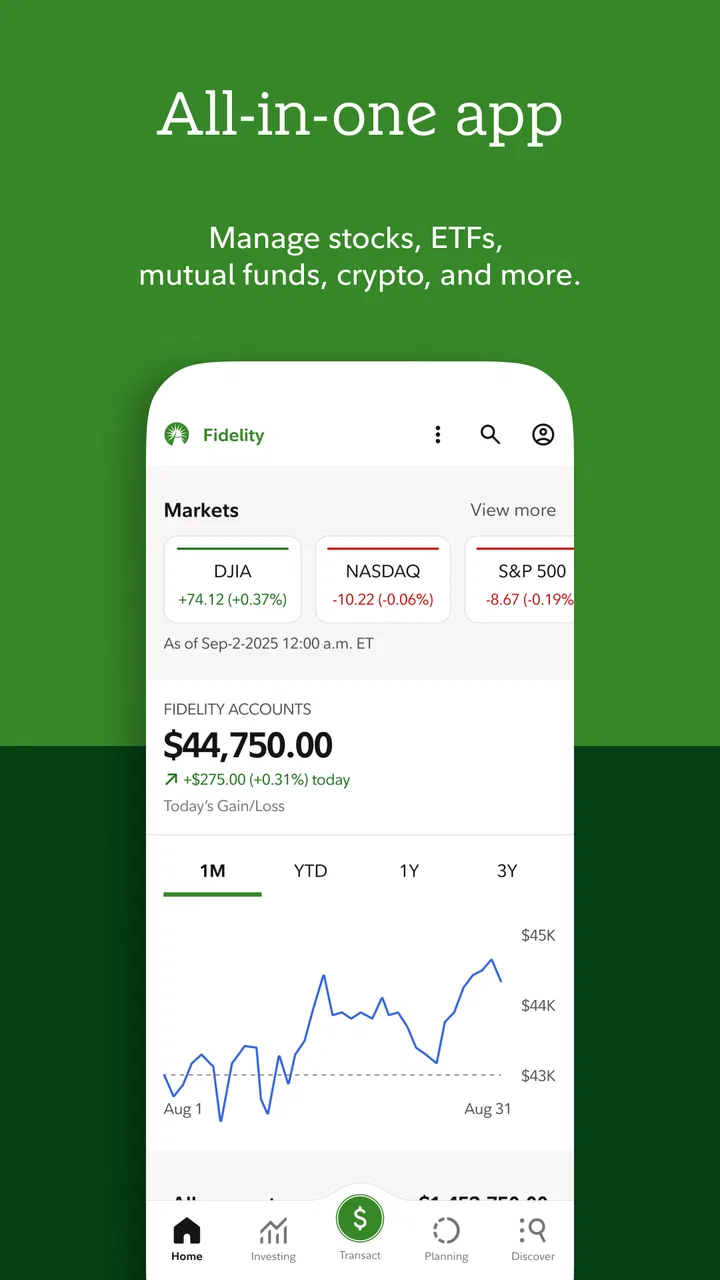
Fidelity Investments is the kind of finance app I would judge less by its polished appearance and more by how clearly it lets me understand what is happening with my money. Developed by Fidelity Investments, it brings investing, saving, and planning into one mobile experience, and it is free to download for everyone. After spending time with it, I see the appeal: it can become a practical home base for someone who wants fewer separate financial tools. At the same time, it is not a magic shortcut to better investing. The quality of the experience depends heavily on how comfortable you are making financial decisions yourself.
The app has been available since December 15, 2010, and its current version is 4.27. That long presence matters to me because a finance app needs to feel like a service I can return to over time, not a temporary budgeting experiment. Its audience is also substantial, with more than five million installs, about two hundred ten thousand ratings, and a 4.2 average. Those figures suggest that it has reached a broad group of mobile investors, although popularity alone is not proof that it will suit every financial situation.
How Fidelity Investments feels when money decisions matter
I find Fidelity Investments most useful when I decide what I want to learn before opening it: a balance check, a review of recent activity, or a deliberate look at a longer-term goal. That small pause keeps convenience from turning into constant monitoring and gives each visit a purpose. From there, the next thing I would do is tune the app’s settings and my own routine so that useful information stays visible without making every update feel urgent.
You May Also Like

 Blood Strike: 2.5 Anniversary
Blood Strike’s Loadouts Turn Every Drop Into a Tactical Gamble
A close look at Blood Strike’s custom loadouts: how fast access to signature weapons reshapes its battle royale rhythm, rewards preparation, and narrows the gap between fights.

 Pandora - Music & Podcasts
Pandora’s Music Is Easy to Start, but Harder to Recover
Pandora’s strength is its low-effort path from a seed to a station. Its weak spot is how much confidence it asks you to place in connection, setup, and quiet recovery.

 8 Ball Pool
 Is Built on Rivalries, Rematches, and Routine
A close look at the rivalries, rematches, shared routines, and unanswered safety questions that turn a quick pool match into a persistent mobile community.

 Samsung Music
’s Quiet Strength Is Playing What You Already Own
Its reach comes less from spectacle than from dependable access to a personal library. That simplicity is both the app’s strongest retention engine and its ceiling.

 AccuWeather: Weather Radar
AccuWeather Review: A Quick, Clear Forecast for Everyday Decisions
For everyday plans, the best forecast is the one you can understand quickly. AccuWeather makes rain timing, radar, and local conditions easy to act on, with a few trade-offs.

 Hill Climb Racing
Why Hill Climb Racing Still Turns Crashes Into One More Run
A tiny car, a bumpy hill and one more upgrade: Hill Climb Racing keeps resurfacing because its simple chaos makes every near-miss feel personal.
More From Our News Desk



A finance app built around a wider relationship
My first impression is that Fidelity Investments is designed for people who want their financial life connected rather than scattered across several specialist apps. A typical user might check an investment account, review savings progress, and look at a longer-term plan in the same place. That arrangement is more useful than it sounds. When financial information is split between a brokerage app, a separate savings tool, and a planning website, it becomes easy to lose the connection between daily choices and long-term goals.
The trade-off is that a broad finance app can feel more demanding than a single-purpose investing app. A beginner who only wants to buy a simple investment may encounter more account areas, terminology, and decisions than expected. I would not describe the experience as difficult by default, but I would approach it with patience. The app is better for someone willing to learn what each account and action means than for someone looking for a completely guided, hands-off solution.
That distinction is important when comparing it with usual alternatives. A basic savings app often focuses on balances and automatic habits, while a dedicated trading app may emphasize fast market actions. Fidelity Investments sits closer to an all-round financial workspace. Its strength is continuity between investing, saving, and planning; its weakness is that the wider scope can make the first visit feel less immediately focused.
Trust starts with visible choices, not branding
Because this is a finance product, I pay attention to moments where the app asks me to act, confirm, or provide information. The most reassuring pattern is not a bold promise of safety but a clear separation between viewing an account and taking an action. Before moving money or changing an investment decision, I want to know exactly which account is involved, what the action means, and whether I am making a one-time choice or setting up something ongoing.
I also prefer to review account details deliberately instead of treating the app as a passive dashboard. A useful routine is to open the relevant account, check the displayed balance and activity, and only then decide whether any action is necessary. This sounds basic, but it reduces the chance of confusing available cash with invested value or reacting to a short-term movement as if it were a long-term problem.
Fidelity Investments benefits from being associated directly with Fidelity Investments rather than presenting itself as an anonymous financial tool. Still, I would not let the developer name replace my own caution. I would use a strong device lock, avoid signing in on shared devices, and read confirmation screens instead of tapping through them. Those habits are especially important because a mobile finance app puts sensitive decisions close to the same screen used for ordinary notifications and entertainment.
Account control is more important than constant activity
One of the best ways to use this app is to decide in advance what I want it to help me monitor. For example, I might use it for a weekly review rather than opening it every few minutes. A scheduled check can include recent activity, cash position, investment allocation, and progress toward a specific goal. This approach gives the app a clear job and helps prevent unnecessary reactions to normal market movement.
For a new investor, I would start by learning the difference between the available account areas before placing any order. The app can bring several financial tasks together, but that convenience also means a careless tap may have more consequence than in a simple budgeting application. I would treat every transfer, contribution, and investment instruction as a separate decision, even when the app makes the process look quick.
A less obvious benefit of this workflow is that it turns the app into a record of decisions rather than a source of emotional prompts. Before changing anything, I would write down the reason: a planned contribution, a change in personal circumstances, or a deliberate adjustment to a long-term strategy. If the reason is only that the market moved today, waiting is often the more disciplined choice.
Where sensitive moments deserve extra attention
Finance apps become most sensitive when they handle identity, account access, transfers, and investment instructions. I would slow down at each of these points. I would verify that I am in the intended account, check the destination of any movement of money, and review the final confirmation before submitting. If the app presents a summary, I would use it as a checklist rather than assuming the details are automatically correct.
I would also avoid making important decisions while distracted. A phone screen encourages quick actions, but investment choices can have consequences that last much longer than the few seconds needed to tap a button. Fidelity Investments is most useful when I use its convenience to review information carefully, not when I use convenience as a reason to rush.
Another practical point is notification discipline. I would keep only the alerts that help me notice meaningful account activity and avoid turning every market movement into an interruption. Too many prompts can make an investor feel obliged to act. The app can support awareness, but the user still needs a personal rule for when information deserves action and when it is simply noise.
Who will get the most from the combined approach?
I think the app is a strong fit for someone who wants a single Fidelity-centered place to manage several parts of a financial plan. It makes particular sense for a person who is moving beyond a basic savings account and wants to understand how saving, investing, and planning relate to one another. It can also suit an existing Fidelity customer who would rather review financial information on a phone than depend on a desktop browser.
Consider an everyday scenario. I might receive income, set aside money for a near-term expense, and then review whether an additional amount belongs in a longer-term investment account. Instead of treating those as unrelated tasks, I can use the same app to look at the broader picture before deciding. The useful part is not that the decision becomes automatic; it is that the information is closer together, so I can make the decision with better context.
That scenario also shows why I would not recommend the app blindly. Someone who needs a simple spending tracker may find a dedicated budgeting app easier to understand. Someone who wants an extremely narrow, beginner-first investing experience may prefer a service that hides more complexity. And someone who is uncomfortable choosing investments or interpreting account information should consider whether they need personal financial guidance rather than another self-directed tool.
Small habits that make the experience safer and clearer
- Separate checking from acting: use one visit to review balances and activity, then make decisions only after you understand what you saw.
- Confirm the account context: before submitting a transfer or investment instruction, check which account is selected and read the final summary.
- Use a written purpose: note whether a contribution supports an emergency reserve, a planned purchase, or a long-term goal before moving money.
- Reduce emotional checking: choose a regular review rhythm instead of opening the app every time the market changes.
- Keep access personal: protect the phone itself and avoid treating a finance session like an ordinary social or shopping session.
These habits are not flashy features, but they are where I see the most practical value. The app can put information and controls within reach; it cannot decide whether a particular investment fits my circumstances. That responsibility remains with me, and the interface is most helpful when it encourages deliberate review rather than impulsive activity.
What the free price does and does not mean
The app itself is free, which removes an obvious barrier for someone who wants to explore Fidelity’s mobile tools. I would still separate the download price from the financial decisions made through the service. Free access does not mean that every possible account action, investment choice, or financial outcome should be treated casually. The important question is whether I understand the account terms and the decision in front of me.
I also would not choose it solely because it costs nothing to install. A free app that I find confusing is less useful than a paid or differently designed tool that matches my needs. Fidelity Investments earns its place on my phone when its combined view helps me make more informed choices, not simply because it is available without an upfront charge.
How the app compares with simpler alternatives
Compared with a savings-only application, Fidelity Investments offers a wider perspective but asks me to understand more. A savings tool may be preferable when my only objective is building a cash cushion and seeing progress toward a short-term target. In that case, investment sections and planning options may add distraction rather than value.
Compared with a focused trading application, Fidelity Investments feels more suitable for someone who wants investing to sit inside a larger financial plan. A trading-first product may be better for an experienced user who prioritizes specialized market tools and rapid execution. I would choose Fidelity’s app when the surrounding account picture matters as much as the individual investment action.
Compared with a traditional desktop-first service, the mobile format is more convenient for quick reviews, but convenience can encourage overuse. I like being able to check information without sitting at a computer, yet I would still reserve complex decisions for a calm setting where I can read everything properly. Mobile access is an advantage only when it improves judgment rather than speeding up every impulse.
Questions I would settle before relying on it
If I were deciding whether to install it, I would first ask whether I want one app for investing, saving, and planning or whether I prefer separate tools with simpler purposes. Fidelity Investments is most compelling when consolidation is genuinely useful. If I only need one narrow function, its wider structure may not justify the learning curve.
I would next ask whether I am comfortable managing financial choices independently. The app can organize information and make account access convenient, but it does not remove the need to understand risk, time horizon, and the purpose of each account. If I cannot explain why I am making a particular move, I would pause instead of assuming the app should decide for me.
I would also consider how often I realistically want to monitor my finances. For someone who wants a regular, thoughtful review, the app can be a useful routine. For someone likely to check constantly and react to every change, the same easy access may become a source of anxiety. In that case, a less market-focused routine or a more guided financial service could be a better match.
Finally, I would ask whether the app’s account controls and confirmation steps feel clear enough for me personally. Financial trust is not only about the company behind a product; it is also about whether I can see what I am authorizing. If a screen leaves me uncertain about the destination, timing, or purpose of an action, I would stop and resolve that uncertainty before continuing.
My cautious verdict
After reviewing it as a finance app, I see Fidelity Investments as a capable choice for people who want investing, saving, and planning brought into one mobile workflow. Its free availability, broad reach, and 4.2 average from roughly two hundred ten thousand ratings show why it attracts attention, while its Everyone age rating makes it accessible to a wide audience. Those details are useful context, but they do not replace a personal fit test.
The strongest reason to use it is the connected view of your financial life, not the promise of effortless investing. I would recommend it to a careful self-directed user who values convenience but is willing to verify account details, read confirmations, and make decisions with a long-term purpose. I would be more hesitant to recommend it to someone seeking a very simple savings tracker, a highly specialized trading terminal, or personal advice at every step.
My final advice is to begin slowly: explore the account structure, establish a review routine, and treat every money movement as a decision worth checking. Used that way, Fidelity Investments can be a practical daily companion without becoming a trigger for constant market reaction. Its real value comes from giving me more context and control in one place, while still leaving the most important responsibility—deciding what is appropriate for my goals—with me.
FAQs for Fidelity Investments
01What features does the Fidelity Investments app offer?
The Fidelity Investments app provides a comprehensive suite of features for managing your investments. Users can trade stocks, ETFs, and options, access real-time quotes and market data, analyze performance with advanced tools, and receive personalized alerts. Additionally, the app offers educational resources to help users make informed financial decisions.
02Is the Fidelity Investments app secure for financial transactions?
Yes, the Fidelity Investments app employs robust security measures to protect your financial information. It uses advanced encryption technology, two-factor authentication, and biometric login options such as fingerprint and facial recognition. The app also offers fraud detection systems and alerts to ensure your account remains secure.
03Can I access customer support through the Fidelity Investments app?
Absolutely. The Fidelity Investments app provides multiple avenues for customer support. Users can access live chat, phone support, and an extensive FAQ section directly within the app. For those requiring in-depth assistance, there are options to schedule appointments with financial advisors or visit local branches.
04Are there fees associated with using the Fidelity Investments app?
While the Fidelity Investments app itself is free to download and use, users should be aware of potential fees related to trading and account management. These may include commissions on trades, margin interest, and fees for specific services or account types. It’s recommended to review Fidelity’s fee schedule for detailed information.
05Is the Fidelity Investments app beginner-friendly?
Yes, the Fidelity Investments app is designed to accommodate users of all experience levels. It features an intuitive interface and provides educational resources, including tutorials, articles, and webinars, tailored for beginners. The app also offers a demo account option, allowing new users to practice trades and explore features without financial risk.
Pros
- User-friendly interface for easy navigation.
- Comprehensive investment tools available.
- Real-time market updates and alerts.
- Secure login with biometric options.
- Educational resources for beginners.
Cons
- Limited customization in portfolio tracking.
- Occasional glitches in mobile app.
- Some features require a premium account.
- Customer support wait times can be long.
- Complex options may overwhelm new users.

Fidelity Investments
Gallery